
Introduction to BIM and its advantages over Traditional Drafting

Updated: Jul 27, 2023
Building Information Modeling (BIM) is taking over the AEC (Architecture, Engineering and Construction) industry.
The idea of BIM dates way back in 1970s but its methodology as a BIM software only existed in the early 20th century due to the maturity of our computer technology. Given this fact, the adoption of BIM in the Philippines has been slow and faces many difficulties. In the 2019 survey conducted by the Journal of Construction Engineering, Technology and Management, only one-third of the Philippine’s construction industry’s stakeholders have adopted BIM.
Times are changing and we must move with it. One of the major problems in the construction industry is inefficiency and waste. It is always at the expense of time and money when things don’t go according to plan. We, as Master Plumbers, often have this difficulties of communicating our design during the construction process. And as our plumbing technology advances, so should be in design of our plumbing system and our need to deliver it as accurately as possible.
What is BIM?
BIM or Building Information Modeling is a process for creating and managing information in a construction project throughout its whole life cycle. It is a highly collaborative process that shares detailed information allowing professionals in various disciplines – such as architects, engineers, contractors, building owners, and utility managers to design, construct, and coordinate within one 3D model. Its comprehensiveness allows stakeholders to work with and contribute to projects in real-time, while leaving cost, complexity and time to a minimum.
Advantages of BIM
Visualize Projects in Preconstruction


The images show the difference between AutoCAD and Revit software – A Hospital renovation project in Davao where BIM is used to translate CAD drawings into actual representations of the site.
BIM uses 3D virtual presentations which simulates the actual conditions of the project. It shows how different systems should be built and placed; this reduces installation mistakes and saves money from wastage. It also identifies potential issues at the onset of the design process, where problems are resolved in the virtual world thus reducing the consequences that arise during construction.
Improve On-Site Collaboration and Communication
Source: Google images
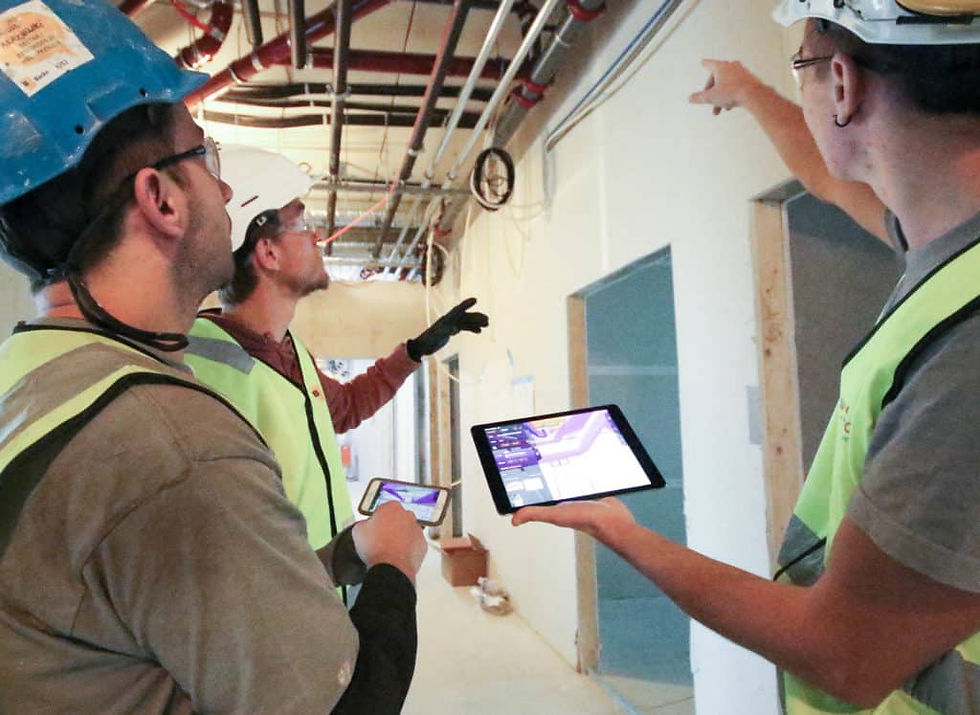
Relaying information to site workers is one of the challenges in construction. Aside from the technicality of the drawings, on-site installation practices are sometimes not considered. Some workers and professionals might neither have the capability nor the experience in the delivery of these drawings. In having BIM, technical specifications are translated into 3D models which eases the communication barrier among designers and workers.
Model-Based Quantity Survey and Cost Estimation

An example of Quantity Survey where BIM is also programmed to calculate Fixture Units used for pipe sizing calculations.
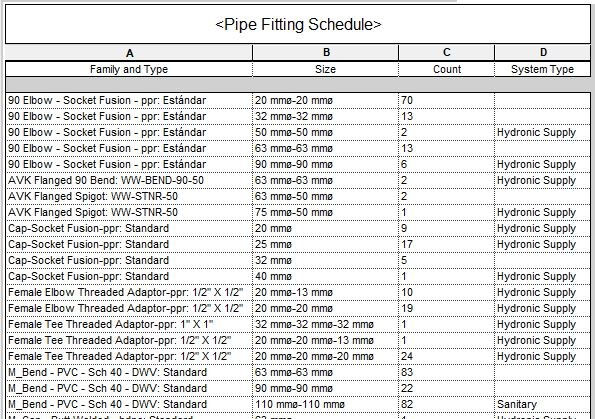
An example of Cost Estimation of fittings. The parameters can be set according to the BIM user’s preference.
BIM does not only confine itself to 3D Modeling, as it is also used for Cost Estimation, Value Engineering and Quantity Surveys. In the traditional way of estimation, only after the completion of a well-prepared document – when all the details are available and the exact amount of materials and labor are known – can an estimate take place. Even so, this labor-intensive and time-consuming process is still susceptible to human error. As a result we tend to drastically increase our contingencies to cover up this deficiency. This would later result in unnecessary wastage.
With BIM, cost estimation is through automation and since the amount of information and detail is placed at the conceptual stage, it can go hand-in-hand with the design process and can be separated into phases. It is also flexible to changes as each component is imbued with data that can be modified according to the designer’s preference. This is convenient especially to price fluctuations in the market.
Better Coordination and Clash Detection

Indoor arena project in Davao where clashes are detected through the use of BIM. As seen, duct size is in conflict with structural framing and clashes are also found in fire sprinkler and lighting layouts.
Traditional drafting usually produces plans that are discipline specific, this means that the consideration of other disciplines is often overlooked. Usually, these things are evaluated over a separate technical support and control department, where consolidation and approval take time. With BIM, the project is coordinated from conceptualization to implementation. This means that even at the beginning, the MEP consultants, contractors, product suppliers, and stakeholders are involved in the process and does not practice exclusivity to its designers.
Mitigate Risk and Reduce Cost
One of the great advantages of using BIM is that it can detect clashes even before construction starts. It reduces the amount of information requests needed on site and avoids last-minute changes or revisions due to a compromised layout. One known example of this is the height clearances of utility systems that often clashes with the structural framing, or establishing ceiling heights that are short-handed for the plenum.
Its ability to test performance or changes beforehand is expected to save up time, cost, and energy.
Streamline Facility Management and Strengthen Building Handover

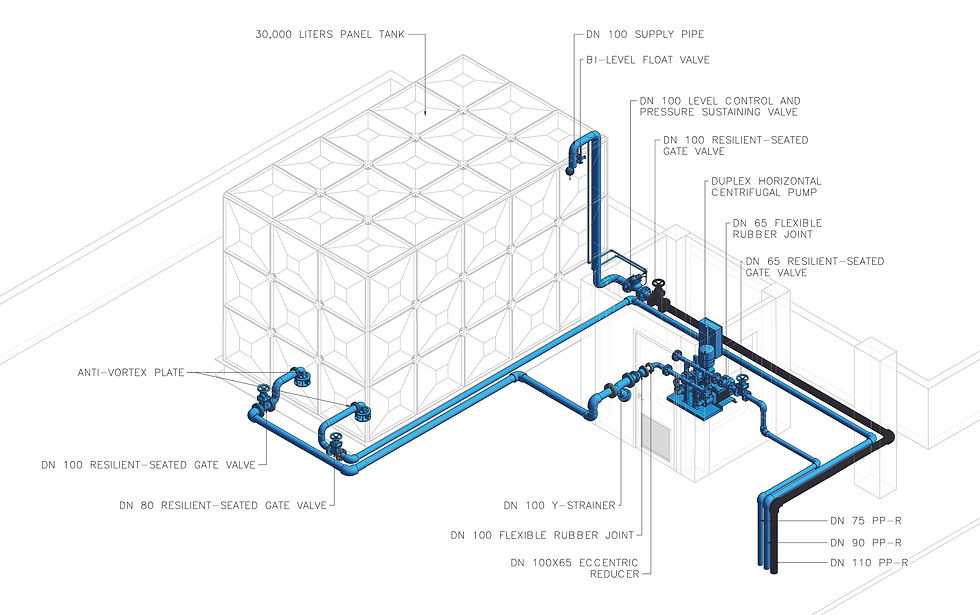
Water supply distribution of a High-Rise Residential Condominium project in Davao. Disclaimer: Ownership of BIM model only and not the plumbing design.
Post-construction services are just as important as the construction itself. The ability of a building to perform overtime and reduce the life-cycle cost, solely depends on the facility management and maintenance operations. BIM is an invaluable tool for this realization. Data can be sent into different file formats for post-occupancy use. Also, during periodic maintenance and renovations, with the use of a BIM model, the assigned personnel can easily pinpoint the pipes, valves, ducts, or special equipment where the location of these systems are mostly hidden.


Plan, Section and 3D View of Sanitary Drainage Layout of a High-Rise Residential Condominium in Davao. Disclaimer: Ownership of BIM model only and not the plumbing design.
TRADITIONAL DRAFTING | BUILDING INFORMATION MODELING |
SCOPE: Designed to have widespread commercial use of 2D & 3D CAD production | SCOPE: Creates comprehensive models that use real-life information. Applicable in 2D/ 3D/4D/5D Modeling |
DETAIL: Precise 2D linework of floor plans and elevations. Offers total manual control over all elements | DETAIL: Modeling, cost schedules, clash detection & revision management |
USERS: Designers, Executing Contractors, Subcontractors, Suppliers (Single-User) File must be updated form time-to-time and constantly coordinated with other disciplines. | USERS: Architect, Structural Engineer, MEP Engineers, Developer, Project Management, Construction Management, BIM Coordinator, Stakeholders, Building Owners (Multi-User) Allows worksharing where a number of users can work on a single file. |
DATA MANAGEMENT: None | DATA MANAGEMENT: Creates all main building elements and produces information regarding manufacturer, model, cost, structure, and phase information. |
FILE FORMATS: DWG, DWF/DWFx, DGN, DXF | FILE FORMATS: DWG, DXF, DGN, SAT, DWF/DWFx, FBX, NWC, gbXML, IFC |
While the benefits of BIM cannot be denied, most veterans in the AEC industry are more comfortable in sticking with the traditional methods rather than opening up to other alternatives. Mainstream appreciation for it can only happen if resources are readily available and information exchange is broadened in the community, especially among Master Plumbers.
Acceptance of BIM as a new normal also starts with each individual who wants to elevate in the plumbing profession. NAMPAP Davao Chapter is trying to bridge this learning gap by helping to improve the competency of Master Plumbers, whom to be at the risk of being left behind from other countries.
Author:
Ar. Dexter R. Calunsag, UAP, NAMPAP
Registered and Licensed Master Plumber
BIM Manager – MEP Global Co. (MEP Design and Consultancy Firm)
PRC Reg. No. 12114


Comments