top of page

Hydraulic Jump in Sanitary Drainage

Updated: 3 hours ago


In plumbing design, RMPs are taught about piping assemblies in sanitary drainage and are familiar with the different parts of the system. However, I believe that most Filipino Registered Master Plumbers have limited view of the concepts and factors behind the code requirements. I am admittedly one of those practicing professionals that have been practicing and just following what others are doing and what books are showing, but have limited know-how of why these requirements are in place in the first place. I have rarely found resources detailing the internal dynamics of sanitary stacks and drainage lines—apart from ASPE documents which are exclusive to members—that explain the rationale behind common code requirements, such as the 2" trap requirement, pressure relief venting, vent stack specifications, and stack and drain sizing requirements. This blog will explore the concepts underpinning these requirements by taking a closer look at them.


Drainage Flow in Stacks


Before we go downstream where hydraulic shock occurs, let's first discuss what happens in the stacks as waste flows down in them. A stack is a general term for any vertical soil or waste pipe collecting wastes from two or more floors. To prevent pressure fluctuations in the system from significantly surpassing the 1-inch water column pressure limit, a stack's design capacity should not exceed one-third of its total volume. Exceeding this limitation would result in traps losing their water seal either by siphonage or blowout. The mandatory 2-inch water seal for traps is derived from this constraint, incorporating a 100% safety margin.


The drainage capacity of a stack is based on the allowable ratio between the sheet of waste flowing to the cross-sectional area of the stack as the waste is flowing at terminal velocity. Most codes restrict the capacity to 30% of the Cross-sectional area of the pipe.


Figure 1 - Cross-Section of Stack Flowing at Design Capacity

The allowable size is also dictated by how many fixtures are connected, how many branch intervals are connected, and how horizontal drains connect to the stack. The following table shows the Maximum capacities of the stacks based on the ratio of cross sectional area of the pipe:


Maximum Capacities of the Stacks (gpm)

Pipe Size

in.

r = ¼ (25%)

r = 7/24 (30%)

r = 1/3 (33.3%)

2

18.5

23.5

-

3

54

70

85

4

112

145

180

5

205

270

324

6

330

435

530

8

710

920

1,145

10

1,300

1,650

2,055

12

2,050

2,650

3,365

Source: ASPE 2024 CPD Review Guide


When wastewater enters the stack from the horizontal branch, it accelerates due to gravity and within a short distance, it forms as a sheet flowing around the inner walls of the stack under the influence of gravity, water viscosity, surface tension, and air pressure. Surface tension keeps the water film cohesive and continuous around the wall instead of breaking into droplets. The wastewater flows like a hollow-core with the air in the middle until it reaches terminal velocity at a certain distance usually at 3 to 4.5 meters from the point of entry.


What Causes Hydraulic Jump?


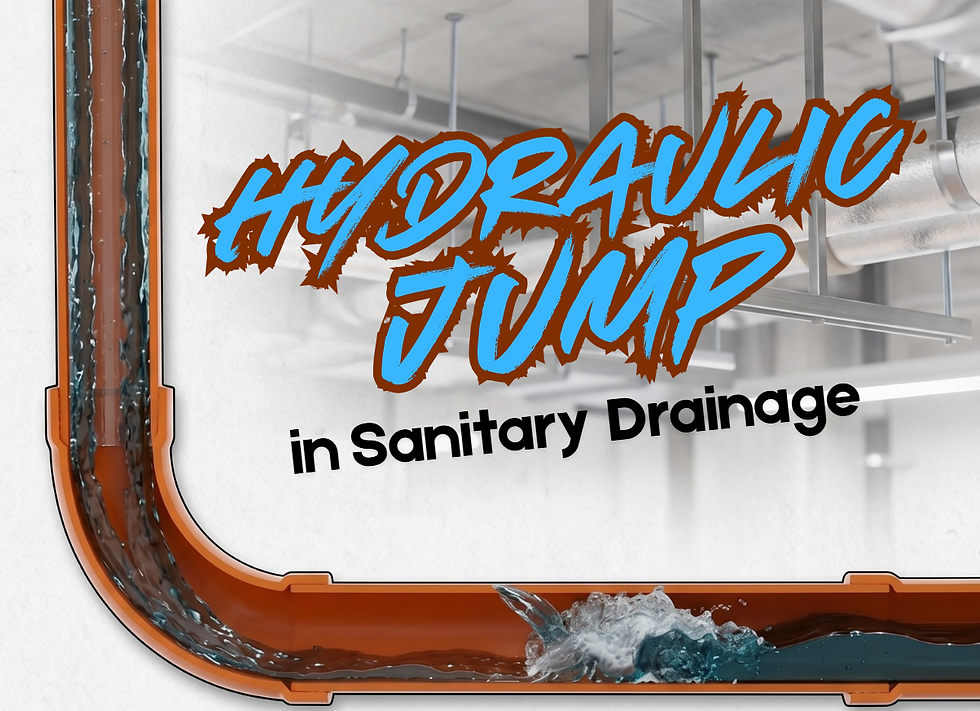
Air in contact with the wastewater flowing down creates friction. As the waste flows down, friction starts to drag the air together with the wastewater and will cause them to flow at the same speed. As the wastewater enters the connection at the base of the stack and goes into the building drain, a sudden decrease in velocity occurs a few pipe diameters of the connection because of the change to horizontal flow. While the wastewater at the front of the flow transitions to a slower velocity, the wastewater flows behind it starts to pile up creating a turbulence and sudden change in depth such that it would suddenly close and fully fill the cross-sectional area of the pipe. This sudden change in depth is what is called hydraulic jump.


Figure 2 - This image shows the area in the building drain where hydraulic jump occurs.

Mitigation of the effects of a Hydraulic Jump


As discussed earlier, air was travelling at the same speed together with the wastewater up to the base and to the horizontal drain, however, because of the sudden blockage by the piled-up wastewater several pipe diameters along the horizontal drain, the air at high velocity builds up and creates sudden surge in atmospheric air pressure at the base of the stack. This is the reason a relief vent is necessary; it connects to the vent stack, diverting the positive pressure surge, which then exits through the stack vent to the roof outlet. The absence of a relief vent would cause the positive pressure to seek the path of least resistance, forcing its way through the nearest fixture's trap seal. This action blows out the trap seal and releases hazardous sewer gases into the building's interior.

Figure 3 -  Shows an example of the connection of a Relief Vent.
Figure 3 - Shows an example of the connection of a Relief Vent.

The hydraulic jump phenomenon typically takes place within a distance of 10 times the stack pipe diameter, measured from the stack's connection point to the building drain. To avoid issues in this zone, branch connections are prohibited here. At stack offsets, instead of connecting any branches directly within the stack offset, the recommended practice is to install a separate collector drain and connect it at least 0.6 meters below where the offset joins the lower stack section.


Figure 4 - Shows an example of branch connections within the stack offset connecting separately at the lower stack.

As Registered Master Plumbers, continuous improvement hinges on more than just meeting code requirements—it demands a deep understanding of the 'why.' Mastering the principles and physics behind required limitations and design parameters is the definitive way for us to advance as leading professionals in the plumbing industry, ensuring our system designs are grounded in expert knowledge.


Author:


RMP James Ray L. Magdadaro, NAMPAP, ASPE

Managing Partner - MEP Global Co. (A MEP Consultancy Firm)

Principal Architect - JLM Architects


Comments

Couldn’t Load Comments
It looks like there was a technical problem. Try reconnecting or refreshing the page.
bottom of page